Claire Bingley
Crimson LakeClaire Bingley is a thirteen-year-old survivor whose disappearance and assault transform an ambiguous roadside encounter into the defining case of Ted Conkaffey’s life. Her traumatic recordings later become both evidence used against Ted and the source of a new investigative lead for Amanda Pharrell. The novel presents Claire through testimony, reconstructed memory, and fragments of speech, keeping the distinction between what is known and what remains uncertain at the heart of her story.
Identity and the roadside encounter
Claire is waiting at the Mount Annan bus stop beside an isolated highway when Ted’s car pulls off the road. In the composite memory through which the scene is recounted, she is thirteen but looks younger, and carries a pink Pokémon backpack. Ted says he initially notices the bus stop and the tracks in the dry ground, not Claire; after parking between ten and fifteen metres away, he gets out and sees her watching him.
The account fixes the encounter against unusually precise times. At 12:47 p.m., a passing driver sees Ted pull off the highway and park near Claire. Five minutes later, Claire’s bus passes the stop; its GPS records the time, and the driver and passengers agree that her backpack is on the ground, but Claire is gone. Ted walks around the front of his car, gets in, and drives away without looking back. Witnesses agree that he made some kind of gesture beside the rear passenger door, the side closest to Claire, but the gesture itself is not explained. These details establish his presence at the stop and the sequence of departure; they do not, by themselves, show what happened to Claire.
The scene is also qualified by its narrator. Ted calls his recollection a composite, assembled from what he remembers, what he heard at trial, newspaper accounts, things said in jail, and possible elements of nightmares. He admits that parts may be fabricated even while the fatal moments feel clear to him. Claire therefore first appears not through an independent account of her own, but inside the troubled memory of the man accused in her case—a form that makes uncertainty part of the characterization.
Abduction, survival, and public alarm
Claire is abducted from the stop and taken along dusty back roads to bushland about five minutes away. There she is severely assaulted, including sexually, and left unconscious. She survives, remains in the bush through the night, and eventually makes her way back to the highway. At about six the next morning, roughly seventeen hours after she disappeared, an older driver finds her about ten kilometres south of the bus stop. Claire is badly hurt and unable to explain what happened.
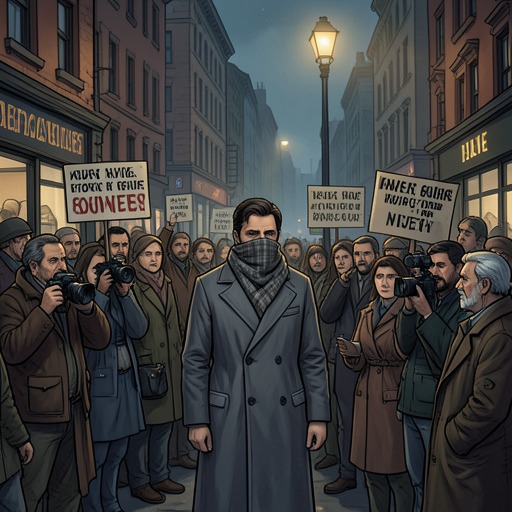
Her disappearance has already become a national story. After Claire’s parents recognize that her absence is out of character, social media and television news take up the search. A missing-person poster is shared around 800,000 times. In the comments beneath one post, a highway driver writes that they think they saw the man; that online identification makes Ted the first suspect publicly named in the account. The speed of the response magnifies the consequences of an incomplete observation: the public learns that Ted was near Claire, while the assault itself has not yet been explained.
Testimony and the effects of trauma
Claire’s later police interviews are recorded soon after her release from hospital, and Ted is made to watch the tapes in court alongside the jury. He recalls a child whose speech is fragmented and whose attention shifts unpredictably. The prosecutor tells the court that her rolling, unsettled eyes are a symptom of post-traumatic stress disorder. Claire also experiences night terrors and difficulty eating. At moments she becomes briefly composed, but then breaks down and turns to her mother.
Her speech contains fragments of ordinary life alongside references to darkness, her teacher, her mother, and a policeman. Investigators ask about the word policeman, and Fabiana Grisham later presses Ted on Claire’s reported statement that her attacker was a police officer. Ted disputes that the fragments identify him. He says the interviews made little sense to him and insists Claire had seen him at the roadside, which could explain why she later selected him from a photographic lineup. The case thus holds two facts in uneasy proximity: Claire identifies Ted, and she had encountered him before her disappearance. Her traumatic, disordered testimony is consequential evidence, but the account does not make it a complete or uncomplicated explanation of the crime.
The white-dog clue and Amanda’s inquiry
Years later, Amanda Pharrell examines Claire’s interview recordings repeatedly and notices that a white dog is mentioned three times: in the hospital interview, in a session with a trauma counsellor, and, as Amanda interprets it, in a recording made while Claire was alone at Parramatta Police Headquarters. Amanda treats those scattered references as a lead rather than as incidental speech. The difference matters: Claire’s fragmented account does not explain the dog’s presence, but it prompts Amanda to search for a connection outside the interviews.
Amanda finds a local newspaper advertisement published four days before the abduction, offering a medium-sized white crossbreed to a new home. She contacts the former owners, who recall that the person who took the dog drove a dark blue ute. A security-camera image from Camden Park, about eight kilometres from the abduction site, shows a blue ute at traffic lights. Two pale shapes at the passenger-side window might be reflections, but Amanda thinks they could be a dog’s ears. A separate image from the Yagoona RSPCA shelter shows a man leaving a white dog tied at the gates; shelter staff find the dog the next morning with an injured front paw. Together, the advertisement, vehicle, and shelter images form the chain Amanda follows, though the images do not conclusively identify the driver or prove the dog was at the bus stop.
Amanda develops a possible explanation: Claire may have heard a dog in distress near the stop and gone toward it, allowing someone to draw her away. This remains Amanda’s reconstruction, not a confirmed account of what Claire did. She has tracked the man associated with the ute for months, but hesitates to give Ted the information. If he is cleared, she fears, he may leave; her reluctance makes the investigation personally consequential as well as a pursuit of the truth about Claire.
Legal and narrative significance
Ted is charged with Claire’s rape and attempted murder, but he is never acquitted. Midway through the trial, the Director of Public Prosecutions withdraws the charges, saying the evidence is not strong enough to prove the case beyond reasonable doubt. The withdrawal is not a declaration that Ted did not commit the crime; the possibility that charges could return remains part of his fear. Claire’s case therefore leaves him in legal uncertainty and under a public suspicion that does not end with the trial.
Claire’s role in the novel is not limited to the accusation that reshapes Ted’s life. Her survival, the limits of what she can communicate after trauma, and the clues Amanda finds in her recorded words keep the question of the attacker open. The narrative neither dismisses Claire’s identification nor treats the prosecution’s failure as proof of Ted’s innocence. Instead, it sets testimony, memory, public judgment, and physical traces beside one another, making the effort to understand what happened to Claire—and the consequences of claiming certainty without enough evidence—central to the book’s moral and investigative tension.